


Playing the piano
Learn
"It's never too late to learn to play the piano"
Learn to play the piano with fun and joy
Whether you are a newcomer, beginner, piano adventurer, late starter, returner or already advanced musician - whether you are 6 years or 88 years young, with or without talent.
"Spread out your musical wings and join us on your musical adventure."
Only professionally trained music school teachers and professionals are available for your piano lessons with adults and children.
After an initial consultation, your piano teacher will respond to your very personal wishes, needs and possibilities and will promote and develop your progress and skills step by step, always taking your wishes and individual needs into account.
In addition, the lessons include varied training with music / harmony and rhythm theory, technique training and much more.
Our music school is open from Monday to Saturday.
Entry is possible at any time. With free scheduling.
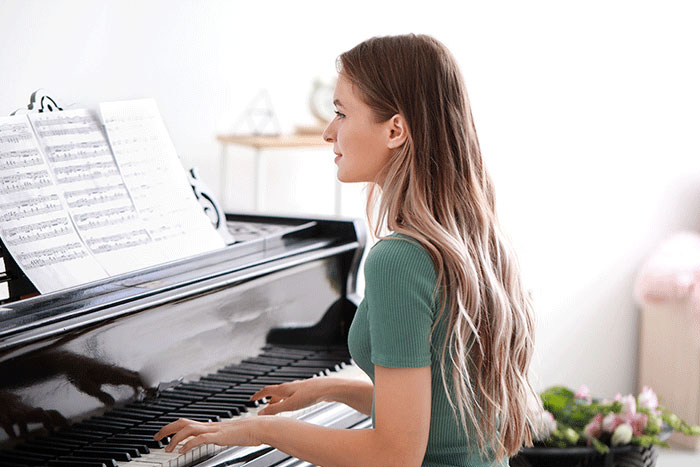
FIT with piano playing
Jumping for joy with your fingers over the keys
When we play the piano, we express our inner self - holistically and with an emphasis on pleasure. We are fully alive.
This joy of playing increases our quality of life and is also a holistic preventative measure against illness. Medical studies continuously show that music and exercise keep us fit and healthy.
Active music-making, especially playing the piano, invigorates, prevents and heals, because playing the piano helps us to restore our psychosomatic balance.
Playing the piano is an ideal way to reduce stress that can lead to illness. As recent neurophysiological studies have shown, the motor skills involved in playing the piano have a positive effect on the vegetative functions of our body, e.g. on its functions such as memory, concentration, ability to combine, etc.
Best brain training
Unlike in the gym, where muscles are strengthened and built up through repetition, variety is the most important thing in brain training! As soon as you have mastered one exercise, you have to look for the next challenge. Anything that requires concentration and brain power is suitable as an exercise.
And this is where playing the piano comes into play. Gerontological studies show that active music-making, especially playing the piano, can have a brain-jogging effect. This applies to young and old. It has been proven that the brain never completely loses its ability to learn until old age. And this can even be increased through regular training. At the same time, mental decline is counteracted. Lost motor skills can also be regained through targeted exercise, which also has a positive effect on the aforementioned brain functions.
There are many reasons for this: One important reason is that important and fundamental human bodily functions are rhythmically shaped and controlled. Rhythm shapes our lives. Our well-being and health depend on our body's rhythmic system. The heart, with its highly symbolic rhythm, is the most vivid example of a rhythmic body organ. The effect of playing the piano on the rhythms in the brain is far greater. The most mysterious human organ is the brain with its twelve billion cells. Its complicated function is based on extremely differentiated rhythms and electrical oscillations. Breathing, with the contraction and expansion of the lungs and the pumping of fresh oxygen, is also rhythmic. This polar continuous rhythm is both vital and emotionally significant.
So we are organized and controlled rhythmically through and through.
For this reason, and because playing the piano embraces us with joy of experience and well-being, playing the piano has a positive influence on us and these bodily functions.
