


Acoustic
Acoustic instruments
Acoustic musical instruments produce sound directly through their mechanical-acoustic function. The term acoustic piano therefore serves as a direct distinction from instruments whose mechanical-acoustic vibrations must also be amplified electronically or which have no mechanical-acoustic component, e.g. the electric piano.
In musicology and linguistic usage, the acoustic piano is also referred to as a conventional, normal or conventional piano.
Acoustic upright vs acoustic grand piano. What is the difference?
A acoustic piano is a keyboard instrument / stringed instrument that produces special piano sounds by pressing the keys. Nowadays, the acoustic piano is usually referred to as a "piano" in German-speaking countries and internationally as a pianino or piano (upright piano). Acoustic musical instruments do not require electricity to operate. The beginnings of the traditional instrument making behind them usually date back several centuries and have hardly changed to this day.
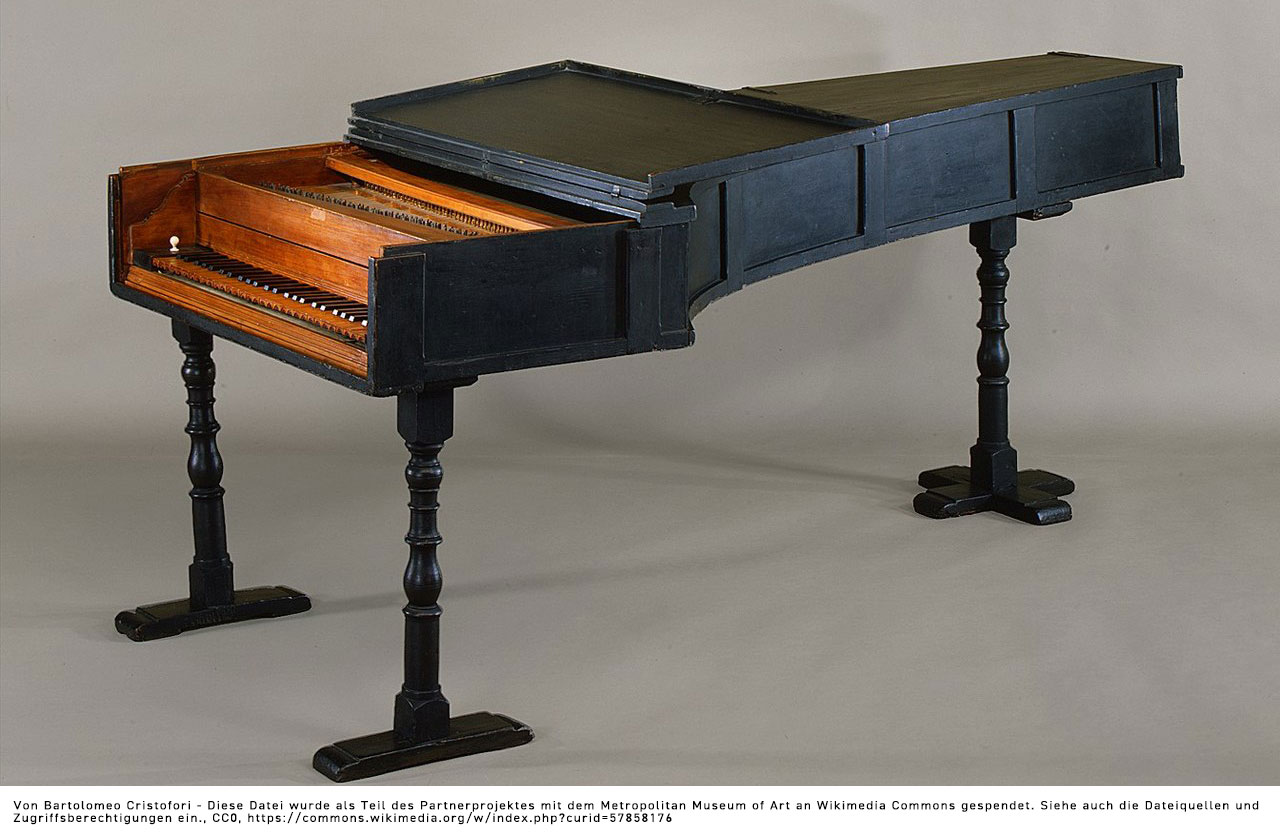
Bartolomeo Cristofori, an Italian musical instrument maker, probably built the first prototype of a fortepiano in the workshops of the Uffizi in 1694. In 1709, an article was published about an instrument built by Cristofori around 1709, the "gravicembalo col piano es forte" (harpsichord with loud and soft), together with a sketch and detailed description of the mechanism. And just a few years later - in 1726 - the organ builder Gottfried Silbermann constructed his first fortepiano on the basis of this publication.
The piano has a width of up to 150 cm and a height of between 90 and 145 cm. It is one of the larger keyboard instruments. Weighing around 200 kg, it appears compact on the outside and has visible keys and pedals, which are located under a lid that can be opened on some models. Inside the piano there are hammer heads, tuning pegs and strings, a cast iron plate and a variety of other components. Depending on the model, a piano is made up of up to 10,000 individual parts."
Most of the parts belong to the mechanism that is responsible for the hammers or hammer heads striking the respective string. The rear part of the key moves upwards and triggers the tongue, which moves the hammers onto the string. At the same time, the damper is released from the string and the note sounds. When the key is released, the damper returns to the string.
A acoustic grand piano offers a much larger and richer sound volume than the piano. The reason for this is the larger soundboard (the belly of the instrument). This soundboard gives the grand piano more sound volume, tonal depth and spaciousness. And the longer a grand piano is, the larger its soundboard. And the playing feel on a grand piano is also much more pleasant and finer to differentiate. Professionals therefore prefer to play on a grand piano, as they can perform and present their skills better on a grand piano.
Acoustic pianos
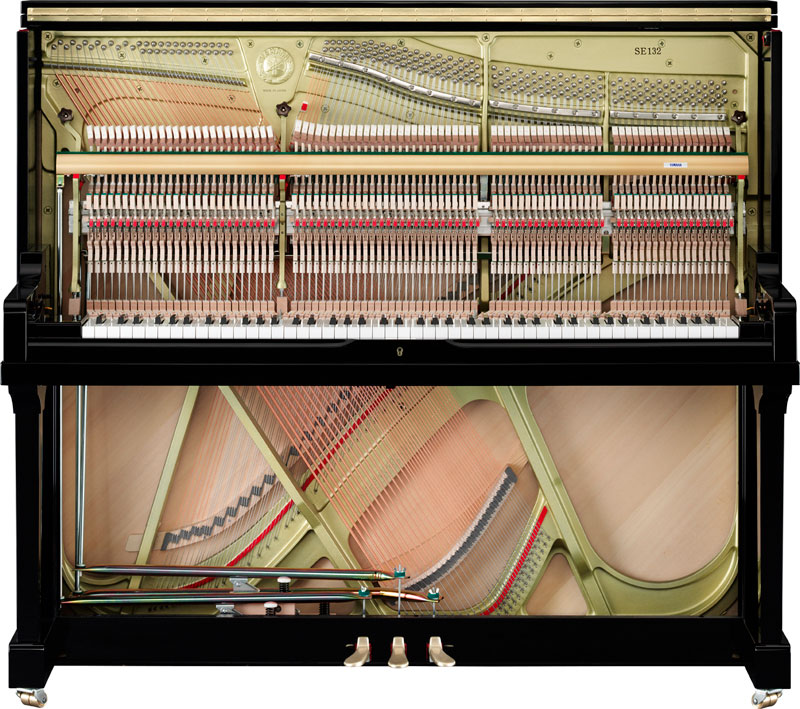
The classical/acoustic piano, also known colloquially as a wall-mounted piano, basically consists of
- from detent and housing
- an acoustic system with cast iron plate (metal frames)
- Soundboard and ribs (sound radiation)
- Bars for the vibration transmissions
- a multi-layer glued soundpost and pegs
- cross stringing
- a keyboard
- a mechanism
- and 2 - 3 pedals (depending on model)
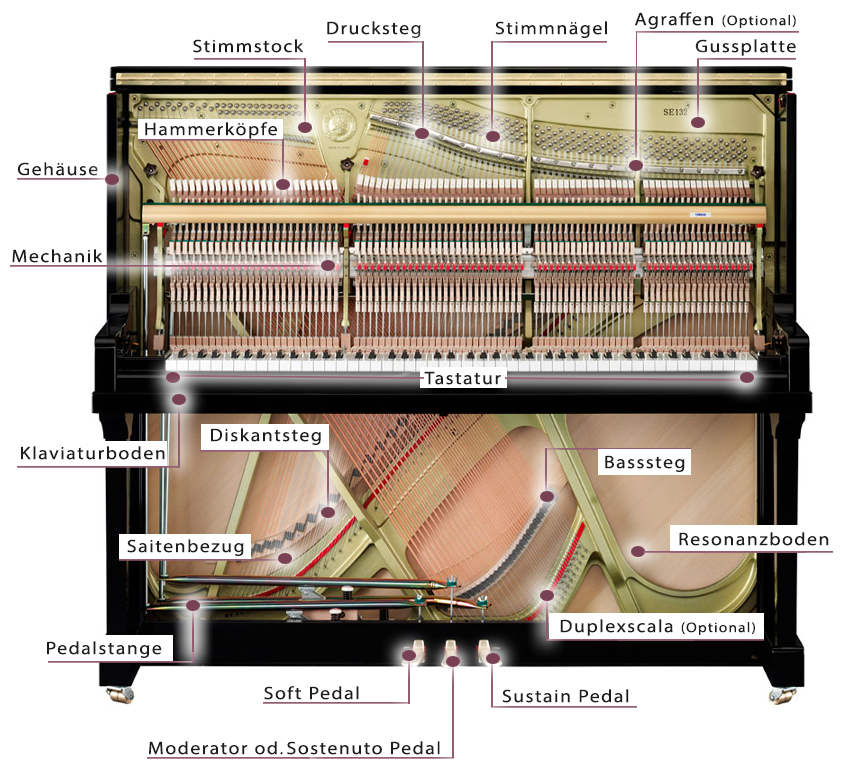
Description of an acoustic piano
Acoustic grand pianos
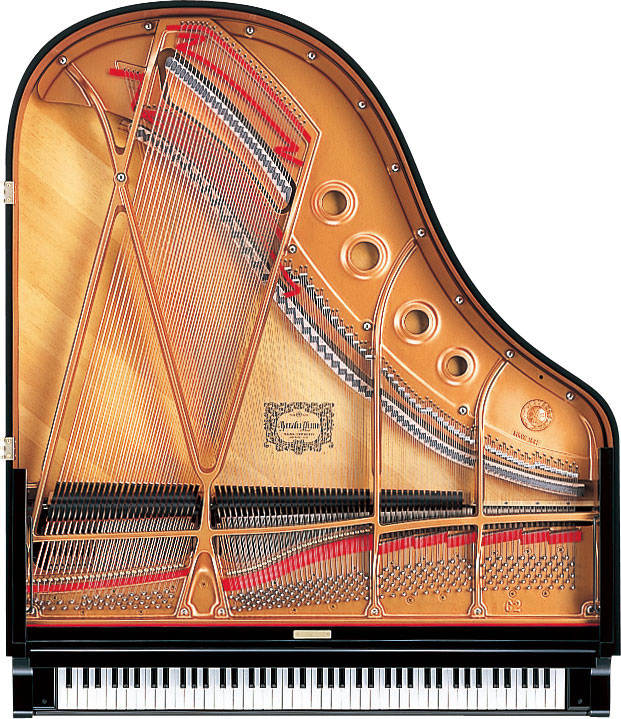
Description of the individual components
Our recommendation for your requirements
We recommend acoustic upright and grand pianos for every performance requirement.
From beginners to professionals.
We can say from our experience and with a clear conscience that anyone who wants to learn to play the piano with lasting pleasure and lasting success and has the means to do so should always opt for an acoustic piano.
One of the most important reasons for this is the unique ear training and the ability to shape and design every note you play. Also the real natural sound and the exactly controllable way of playing, as well as the possibility to bring your temperament into the song. You have certainly read and heard this many times before and we, our team of teachers and your listeners will confirm this time and time again:
There is nothing better than the unique feeling of playing an acoustic piano.
Play quietly or silently on an acoustic piano & grand piano
Coaster
Special coasters are available to prevent the sound of the instrument from spreading through the floor and walls via the piano/grand piano feet. These can be found in our accessories department.
Moderator
You can play the piano quietly on any acoustic piano using the built-in moderator.
Pressing the middle pedal (depending on the model) lowers a felt strip between the strings and hammers, thereby reducing the volume of your playing.
Silent & TransAcoustic systems
From acoustically normal to quieter and completely silent. You have all the options for your piano playing. Read more Silent systems
*knowledge.art
What is an acoustic piano?
The acoustic piano is a keyboard instrument, also known as a "pianoforte". Pianos essentially consist of
- Housing (body)
- Soundpost
- Soundboard
- Strings
- Piano mechanics
- Keyboard
- Pedals
To produce sound, the wire strings are struck by hammers covered with felt (felt hammerheads) so that the vibration of the strings can be transmitted to the soundboard via a bridge. The hammers are attached by a lever mechanism to each end of the usually 88 keys, which together form the keyboard with a range of seven full octaves. In addition to keyboard instruments, the piano can therefore also be counted among the percussion instruments and stringed instruments (chordophones)
Like all stringed keyboard instruments, the piano can be traced back historically to the monochord, from which the psaltery first emerged. In the late Middle Ages, the clavichord was added, followed by the virginal, the harpsichord, the clavicytherium and the spinet in the Renaissance. After B. Cristofori Barolomei invented the piano at the beginning of the 18th century by introducing the hammer action, numerous fashionable special constructions of the instruments were made, especially in the 19th century, such as the lyre grand or the giraffe piano. Of these different designs, only the (fortepiano) grand piano and the upright piano (also known as the wall piano) were ultimately able to establish themselves.
The piano is still the most popular and most played keyboard instrument today, used as a musical instrument in classical music as well as in jazz, folk music and popular music.
How many keys does an acoustic upright or grand piano have?
What is a key, a keyboard?
In keyboard instruments, the key is indirectly responsible for sound production, as pressing it sets a special mechanism in motion to produce sound. On acoustic instruments, one or more strings are vibrated by striking them, for example. The acoustic piano usually has 88 rectangular keys covered with plastic or ivory from past productions, of which 52 are white and 36 are black. Twelve keys are grouped together to form an octave and arranged in such a way that the front row, the so-called lower keys, contain the seven root notes and the back row, the so-called upper keys, complement the five chromatic notes. All of the keys on the keyboard of the instrument, which cause up to 230 strings to vibrate, are also called the "keyboard" or "manual".
to be continued...