


Humidity & Life Saver
Why is the ideal humidity level important for your piano?
Pianos and grand pianos are mainly made of natural materials that react to climatic changes.
You already know these circumstances from your beautiful wooden furniture and doors, which expand or contract at the beginning of the heating period and at the start of spring. This is a natural process that happens over the heating period and the increase and decrease in humidity in your home.
But it's not just your natural furniture that reacts to too dry or too high humidity in the room. Your skin and lungs, your pets and plants and even your immune system also react to an unhealthy indoor climate.
And just like your family doctor recommends for you, we also recommend creating an alkaline and healthy humidity and room climate for your instrument. Naturally with the most important tips, videos and recommendations, all of which you will find on this page.
What humidity is healthy for my upright or grand piano?
The ideal humidity is between 45 and 65 % .
You should be aware that constant fluctuations can cause problems.
Excessive humidity usually leads to mood swings and can cause wood and felt to swell.
However, if the humidity is too low, this will cause drying damage, which you can prevent by using humidification systems, such as a Life Saver system (described below).
We can install an air humidification system by appointment, even for older pianos and retrospectively. We will be happy to advise you in detail.
How can you measure humidity at home?
During our piano services and piano tuning appointments, we always measure these automatically and free of charge. If there is a need for action, we will inform you during the appointment. However, as our appointments are only snapshots and the intervals between them are far too long, we recommend that you take your own measurements.
The simplest option is to measure using a hygrometer. This is a special device for measuring humidity. You can find all hygrometers and information about them in our online store under accessories.
How humidity affects the tuning, action and acoustic system of your upright or grand piano
This graph shows how drastically the tuning pitch varies when your instrument is exposed to fluctuations in humidity over the course of the seasons.

Piano Life Saver Systems
The system ensures uniform climate control by keeping the humidity level constant throughout the year in any climate and environment.
The Piano Life Saver is installed in the instrument out of sight. Models for grand pianos, upright pianos and upright pianos are available.
The advantages of Piano Life Saver systems
- Stabilizes the piano tuning, maintains the tuning pitch and extends the service life of the piano tunings
- Reduces swelling and shrinkage of the mechanical parts, which ensures the best playability and reliable key function
- Prevents rust on strings and metal parts
- Reduces felt wear, avoids sharp tones due to hammers played flat at low humidity and muffled sound due to swollen hammer felt at high humidity.
- Reduces the risk of glue joints coming loose in the piano.
- Preserves the value of the piano for many years.
Fixed buttons
Just as doors and drawers stick in high humidity and become loose in dry air, the piano keys can get stuck if they are struck in high humidity. In a dry environment, the keys can rattle when playing.
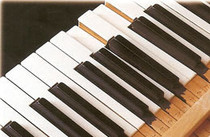
Sluggish mechanics
When you play the piano, you notice how sensitively the keys react to your touch. Thousands of interconnected wooden parts in the action provide the connection between the keys and the hammers. If there is a high moisture content in the action, it becomes stiff and the keys no longer seem to respond as well to your touch.
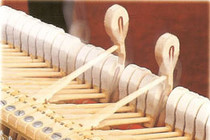
Damage to bridges and soundboard
The soundboard is the largest piece of wood in your piano. It vibrates to amplify the sound of the strings. The bridges of your piano are connected to the soundboard and support the strings.
Over time, the constant changes in humidity and the associated swelling and shrinking of the wood damage the cohesion of the soundboard. You can see this damage in the form of cracks in the soundboard.
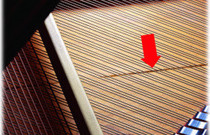
Rust damage
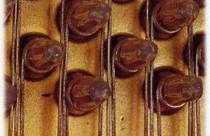
The strings in your piano are responsible for producing the musical sounds. If they are exposed to high humidity for long periods of time, strings corrode and become rusty.
Where rusted strings run over rusted pins, the rust forms a rigid connection between the two. If your piano tuner then turns the pegs while tuning, the rusty, inflexible strings can break.
Contact KLAVIERSERVICE
T 0664 5406 441
E tasten@pianoart.at
Hotline for emergencies: +43(0)664 5406 441
MO-SO, from 06:00 to 24:00